Home Energy Audit: Cost, What to Expect & Rebates (2026)
Short answer: A home energy audit (also called a home energy assessment) is a visit from a trained energy auditor who finds where your house wastes energy. The auditor usually runs a blower door test, an infrared scan and a check of your heating, cooling and insulation, then gives you a prioritized list of fixes. The U.S. Department of Energy puts the typical cost at approximately $250 to $600 or more. In Texas, Oklahoma and Georgia, some utilities and state programs lower that cost or include the assessment as the first step toward a rebate, so check your program before you book.
No cost to check · No obligation · About 2 minutes
Last checked November 2, 2026. Program details come from each utility's or agency's own page. The program, not the auditor or Upgrade Rebates, decides eligibility.
What is a home energy audit?
A home energy audit measures how your home uses energy and shows which upgrades will matter most. ENERGY STAR breaks a professional assessment into five parts:
- Homeowner interview about hot rooms, drafts and comfort problems
- Energy bill review to set a baseline
- Home evaluation: a visual inspection of the envelope and all mechanical systems
- Safety check and testing for leaks, moisture and ventilation
- Recommendations ranked by health and safety, comfort and cost-benefit
DOE says some audits take about an hour and use no special equipment. More thorough assessments take about four hours, use diagnostic equipment and cost more, but give you much more detail.
How much does a home energy audit cost?
DOE's consumer guide says a professional home energy assessment "can cost from approximately $250 to $600 or more." DOE also notes that many contractors charge less for the assessment if you hire them for the upgrades it recommends.
Ways homeowners in our core states may lower the home energy audit cost:
| Where | What the program lists (checked Nov 2, 2026) |
|---|---|
| San Antonio (CPS Energy) | A Home Energy Assessment at no cost to you |
| Georgia Power customers | A rebate for 50% of the assessment cost, up to $150, through the Home Energy Improvement Program. A Program Installer must do the assessment, it's limited to one per calendar year, and it's valid for one year |
| OG&E (Oklahoma), income-qualified | An Energy Advisor home visit, then up to $3,000 in upgrades at no additional cost |
| PSO (Oklahoma), income-qualified | An energy assessment by PSO's provider, Titan ES, as part of Home Weatherization Assistance |
| Georgia's Home Energy Rebates (HER) | The assessment is the first step, done by a program-approved contractor. Georgia warns there "may be costs associated with the home assessment" and says to ask about fees first |
Federal tax credit note: The IRS's energy-efficient home improvement credit once included up to $150 for a home energy audit. It covered improvements made through December 31, 2025, so it doesn't apply to an audit done in 2026.
What to expect during a home energy audit
Before the visit
DOE recommends listing problems you've noticed (drafty or hot rooms, condensation) and having recent energy bills ready. In a Texas or Oklahoma summer, note which rooms never cool down and how long the A/C runs on a hot afternoon.
During the visit
Expect a walkthrough, an attic check and diagnostic tests. DOE says the auditor may also inspect your heating and cooling systems, test for natural gas leaks and check ventilation. Georgia Power's assessment guide adds combustion safety testing for gas water heaters and furnaces.
What is a blower door test?
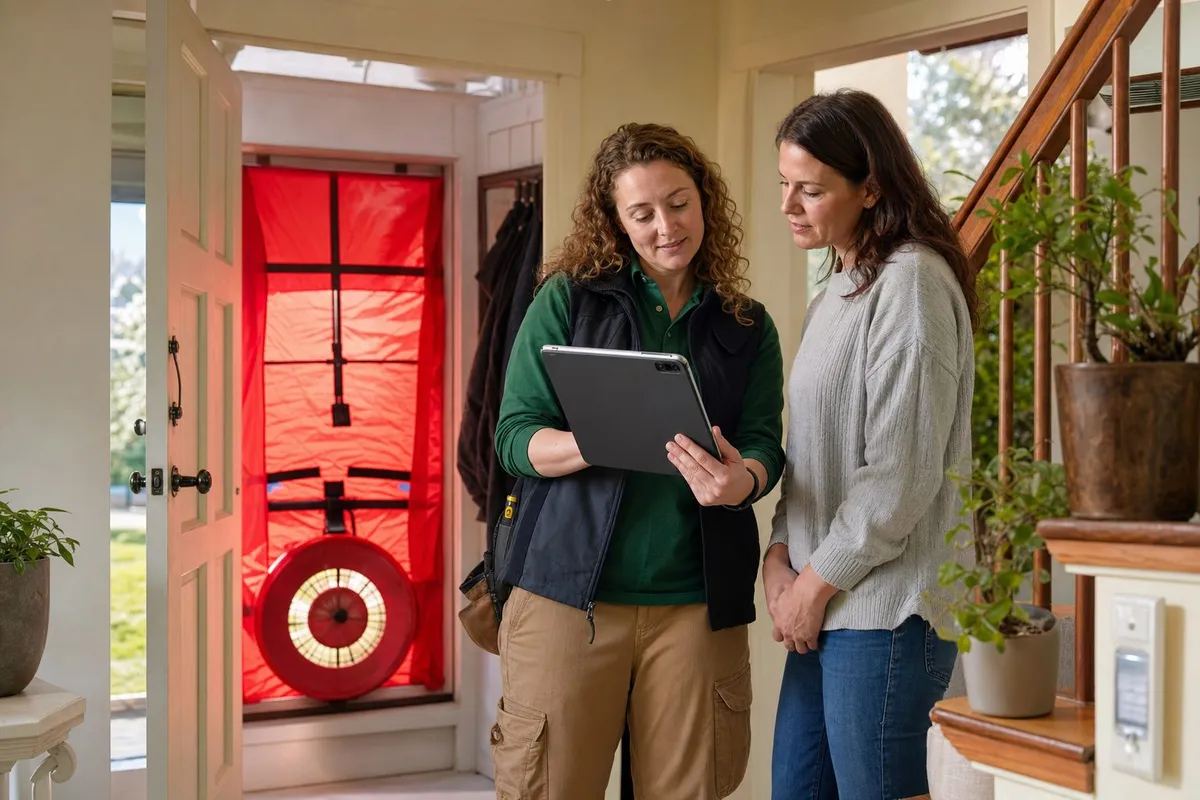
A blower door test measures how airtight your house is. The auditor mounts a powerful fan in an exterior doorway and pulls air out of the house. That lowers the pressure inside, so outside air rushes in through every gap. DOE says to make sure the auditor uses a calibrated blower door connected to a pressure gauge (manometer). Without one, the test can find leaks but can't measure how much air is leaking. Auditors often pair it with an infrared (thermographic) scan that shows hot and cold spots, and a duct blower that measures leakage in the ductwork.
After the visit
You should get a written report with findings and recommended improvements. Some reports estimate costs and savings. DOE describes an optional "test-out" after the work is done, a follow-up test that checks the contractor's work. Ask whether it's included. Some rebates require it: Georgia Power, for example, requires a test-in and test-out for air sealing rebates.
How energy audits tie into rebates
Many rebates are tied to measured or modeled energy savings, and an assessment is how those savings get documented. Here's where things stand in our core states.
Texas: SECO HOMES and HEAR
Texas's State Energy Conservation Office (SECO) says HOMES rebates of up to $8,000 "will be based on household income level and the expected energy savings." HEAR rebates for income-qualified households "can range up to $14,000 per household." But as of SECO's August 21, 2026 update, "Rebates are not currently available." SECO's FAQ says no applications or reimbursements can be processed yet, and that projects started or finished before launch are unlikely to qualify. Don't pay for an audit expecting it to unlock a Texas state rebate yet. Utility programs are where Texans may find help today. See our Texas rebate guide and CPS Energy guide.
Oklahoma: OG&E, PSO and ONG
- OG&E: income-qualified customers may receive up to $3,000 in upgrades at no additional cost. Services include air sealing, duct repair, HVAC tune-ups and attic insulation. After you enroll, OG&E's partner (Skyline Energy Solutions) schedules a home visit. Call 877-898-1759. OG&E rebate guide
- PSO: Home Weatherization Assistance. PSO lists household income of $65,000 or less, a home under 2,200 sq. ft. and a home at least 10 years old. Titan ES does the assessment, and homes weatherized in the past 10 years aren't eligible. PSO rebate guide
- Oklahoma Natural Gas: ONG's residential rebates are for gas equipment (heating systems, water heaters, dryers and ranges). An audit can tell you whether a furnace or water heater upgrade belongs on your list. ONG rebate guide
Georgia: Home Efficiency Rebates and Georgia Power
Georgia's Home Efficiency Rebates (HER), run by GEFA, start with a home energy assessment by a program-approved contractor. The rebate depends on household income relative to area median income (AMI) and on modeled energy savings. Georgia lists maximums of $10,000 (20% to 34% savings) or $16,000 (35% or more) for households under 80% AMI, and $2,000 or $4,000 at 80% AMI and above. HEAR reopened in late October 2026, limited to electrical wiring and panel upgrades done alongside an HER project. Georgia Power separately offers the 50%, up-to-$150 assessment rebate above. See our Georgia Power guide.
How to find a legit energy auditor near you
When you search "energy audit near me," you'll find independent auditors, HVAC companies and insulation contractors. Use this checklist:
- Start with your utility or state program. DOE recommends checking with your electric or gas utility or your state energy office to find an assessor. Georgia's HER has its own approved-contractor directory.
- Ask about certification. DOE says to use a certified assessor. The Building Performance Institute (BPI) is one national credentialing body for home performance work.
- Ask exactly which tests are included: a calibrated blower door, an infrared scan, duct testing and combustion safety. Then ask whether you'll get a written report.
- Confirm the fee in writing before the visit, and whether it's credited if you hire them for the work.
- Check the trade license for any follow-up work: TDLR for HVAC in Texas, the Construction Industries Board in Oklahoma.
- Walk away from guarantees. An auditor can say a project may qualify. Only the utility or state program approves a rebate.
Is a home energy audit worth it?
For most older homes in hot climates, yes. Georgia Power's assessment guide says an assessment is especially useful if your home is more than 15 years old, you recently bought a home more than 20 years old, you're replacing your HVAC system, you're planning a renovation, or you have noticeable hot and cold spots. The report keeps you from spending on the wrong fix, such as a bigger A/C when the real problem is leaky ducts. When a utility covers part of the cost, or a rebate requires an assessment, it's an easy call.
Conclusion
A home energy audit is the cheapest way to find out where your money is leaking before you spend thousands on upgrades. In Texas, Oklahoma and Georgia, your utility or state program may lower the cost, and in some programs the assessment is the required first step toward a rebate. Check what's open at your address first, then book a qualified auditor.
See which audit and upgrade programs may fit your ZIP code, and, in Texas and Oklahoma, connect with a licensed contractor.
Find My Rebates →No cost to check · No obligation · About 2 minutes
FAQ
How much does a home energy audit cost?
The U.S. Department of Energy says a professional assessment costs approximately $250 to $600 or more. Some utilities lower it: CPS Energy lists a Home Energy Assessment at no cost, and Georgia Power rebates 50% of the cost up to $150.
How long does a home energy audit take?
The Department of Energy says a basic audit takes about an hour, and a thorough assessment with diagnostic equipment takes about four hours.
What is a blower door test?
A fan mounted in an exterior door depressurizes the house so the auditor can find and measure air leaks. The Department of Energy says the blower door should be calibrated and connected to a pressure gauge.
Do I need an energy audit to get a rebate?
Sometimes. Georgia's Home Efficiency Rebates start with an assessment by a program-approved contractor, and some utility rebates require test-in and test-out. Many equipment rebates don't. Check your program's rules.
Is the federal energy audit tax credit still available?
No. The IRS says the energy-efficient home improvement credit, which included up to $150 for a home energy audit, covered improvements made through December 31, 2025.
Are Texas HOMES and HEAR rebates open?
Not yet. SECO's August 21, 2026 update says rebates are not currently available, and a launch date depends on DOE approval.
