R-Value Chart: How Much Insulation Do You Need? (2026)
Short answer: R-value measures how well insulation resists heat flow. The higher the number, the better it insulates. For an existing home, ENERGY STAR's R-value chart recommends adding attic insulation to reach R-49 in climate zones 2 and 3, which cover most of Texas, Oklahoma and Georgia, and R-60 in zone 4, which includes the Texas and Oklahoma Panhandles. If you already have 3–4 inches, the targets are R-38 and R-49. Utility rebates often set their own minimums, so check yours before you buy.
No cost to check · No obligation · About 2 minutes
Last checked November 2, 2026. Program terms come from each utility's own page. The utility decides eligibility.
What is R-value?
DOE defines R-value as a measure of insulation's resistance to heat flow: "the higher the R-value, the greater the insulating effectiveness." R-value depends on the type of insulation and its thickness, so 6 inches of one product won't match 6 inches of another. DOE says to check the packaging, or the paper backing on rolled insulation, for the rated R-value.
Insulation R-value chart for existing homes
This is ENERGY STAR's retrofit chart for wood-framed homes, based on the 2021 International Energy Conservation Code (IECC):
| Climate zone | Add to attic: uninsulated | Add to attic: already 3–4 in | Floor |
|---|---|---|---|
| 1 | R-30 | R-25 | R-13 |
| 2 | R-49 | R-38 | R-13 |
| 3 | R-49 | R-38 | R-19 |
| 4A / 4B | R-60 | R-49 | R-19 |
| 5, 6, 4C | R-60 | R-49 | R-30 |
| 7, 8 | R-60 | R-49 | R-38 |
DOE's Energy Saver guide shows a slightly wider range for uninsulated attics in zones 2 and 3 (R-49 to R-60). ENERGY STAR describes its chart as cost-effective levels, and DOE notes that such levels may differ from current local building codes.
Insulation types and where they fit
DOE describes four common types:
- Rolls and batts (blankets): fiberglass, rock wool or recycled fibers such as denim, sized to fit standard stud and joist spacing.
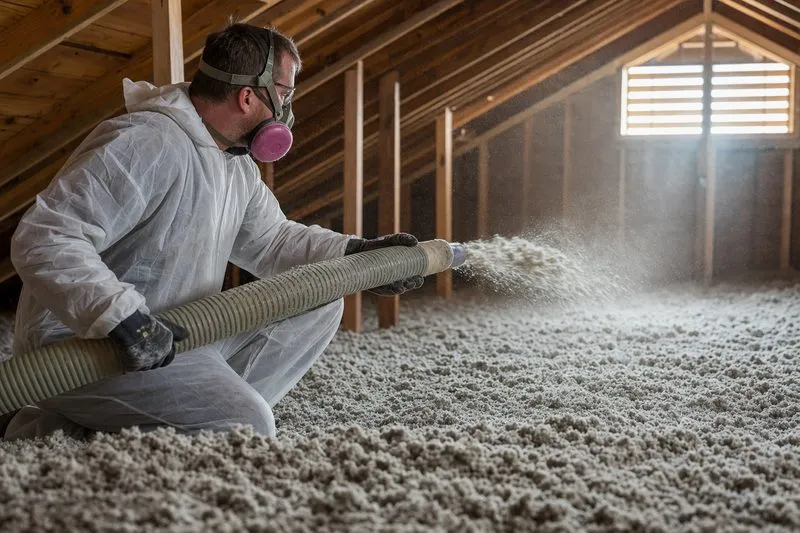
- Loose-fill (blown-in): fiberglass, rock wool or cellulose blown in with special equipment. DOE says it conforms to odd-sized cavities and attics with wires, ducts and pipes.
- Rigid foam: typically more expensive, but very effective for exterior wall sheathing, basement walls and attic hatches.
- Foam-in-place (spray foam): insulates and reduces air leakage. DOE suggests higher R-value products like spray foam for exterior walls and cathedral ceilings, where space is tight, and recommends considering a professional to install it.
Which climate zone are you in?
According to DOE's Pacific Northwest National Laboratory county guide (2021 IECC):
| State | Zones | Examples |
|---|---|---|
| Texas | 1A, 2A, 2B, 3A, 3B, 4B | Harris (Houston), Bexar (San Antonio), Travis (Austin) and Dallas counties are 2A. Denton County is 3A. Potter County (Amarillo) is 4B |
| Oklahoma | 3A, 4A, 4B | Oklahoma and Tulsa counties are 3A. Northern counties such as Kay, Osage, Washington and Garfield are 4A. The Panhandle (Cimarron, Texas, Beaver) is 4B |
| Georgia | 2A, 3A | Fulton and DeKalb (Atlanta) are 3A. Coastal and south Georgia counties such as Chatham are 2A |
How to check how much insulation you have
- Go into the attic safely. Step only on joists, and wear a mask and gloves.
- Measure depth in several spots with a ruler.
- Convert inches to R-value using the product type. For standard-density cellulose, OG&E's rebate guide lists 1 inch ≈ R-3, 8 inches ≈ R-23 and 13 inches ≈ R-38. Other materials differ, so check the bag or ask the installer.
- Compare with the chart. If you're below the "already 3–4 in" column for your zone, adding insulation is likely worthwhile.
- Seal air leaks first. DOE recommends air sealing before you add insulation, and insulation alone won't stop drafts.
Wall and crawlspace insulation
ENERGY STAR's chart also covers walls. When siding comes off an uninsulated wall, blow insulation into the cavity. In zone 3, also add R-5 insulative sheathing, and in zones 4–8 add R-5 to R-10. For crawlspace walls, it recommends R-5 sheathing or R-13 batts in zone 3, and R-10 sheathing or R-13 batts in zones 4A and 4B.
Rebates tied to R-value targets (checked Nov 2, 2026)
Texas
- CPS Energy (San Antonio): attic insulation rebate up to $0.35 per sq ft. CPS Energy rebates
- Austin Energy: attic insulation to R-38, paid at sq ft × $0.03 × the R-value added, plus $45, through Home Energy Savings with a participating contractor. Austin Energy rebates
Oklahoma
- OG&E: up to $500. Existing insulation must be under R-23, the finished attic must reach R-38 or more. As of November 2026, OG&E's Oklahoma attic insulation rebate is open, with applications due December 1. Window and door rebates are closed until 2027. OG&E rebates
Georgia
- Georgia Power: 50% up to $300 (electric heat) or $200 (gas heat). Existing insulation must be under R-19, and you must add R-49 or more. Georgia Power rebates
Amounts can change, and funds can run out. Your utility decides eligibility.
The bottom line
Find your zone, measure what you have, and aim for the R-value chart target, or for your utility's minimum if it's higher. For pricing, see attic insulation cost. Then check what you may qualify for.
No cost to check · No obligation · About 2 minutes
FAQ
What R-value do I need in my attic in Texas?
For most of Texas (zones 2 and 3), ENERGY STAR recommends R-49 for an uninsulated attic, or R-38 if you already have 3 to 4 inches. In the Panhandle (zone 4B), it's R-60 or R-49.
What R-value do I need in Oklahoma?
Most of Oklahoma is zone 3A (R-49 uninsulated, R-38 with 3 to 4 inches existing). Northern counties (4A) and the Panhandle (4B) are zone 4, where the targets are R-60 and R-49.
Is a higher R-value always better?
DOE says a higher R-value means greater insulating effectiveness. ENERGY STAR's chart lists the levels that are cost-effective for each zone, so going far beyond them may not pay back.
How many inches is R-38?
It depends on the material. For standard-density cellulose, OG&E's rebate guide lists about 13 inches for R-38. Check the product's packaging.
Do rebates require a specific R-value?
Often, yes. As of November 2, 2026, OG&E requires a finished R-38 or more, Austin Energy pays for insulation to R-38, and Georgia Power requires adding R-49 or more.
