How Do I Know If I Have a Heat Pump? (60-Second Check)
Short answer: Most Texas homes with central air have one of two outdoor units: a standard air conditioner, which only cools, or a heat pump, which cools in summer and runs in reverse to heat in winter. The fastest clues are an "EM HEAT" or "AUX" setting on your thermostat, an outdoor unit that runs when the heat is on, and an HSPF or HSPF2 rating on the outdoor nameplate. If any of those is true, you most likely have a heat pump.
See if you qualify →
Quick to check · No obligation.
Last checked November 10, 2026. Utility program details change. Confirm on each utility's own page before you sign a contract.
Why it matters before you apply for a rebate
Texas utility rebate programs ask what system you have and what you are replacing it with. Some programs treat heat pumps and central air conditioners as separate measures, and a heat pump replacing electric resistance heat can be handled differently from a like-for-like swap. Knowing your current system lets you read each program's rules correctly and ask contractors the right questions.
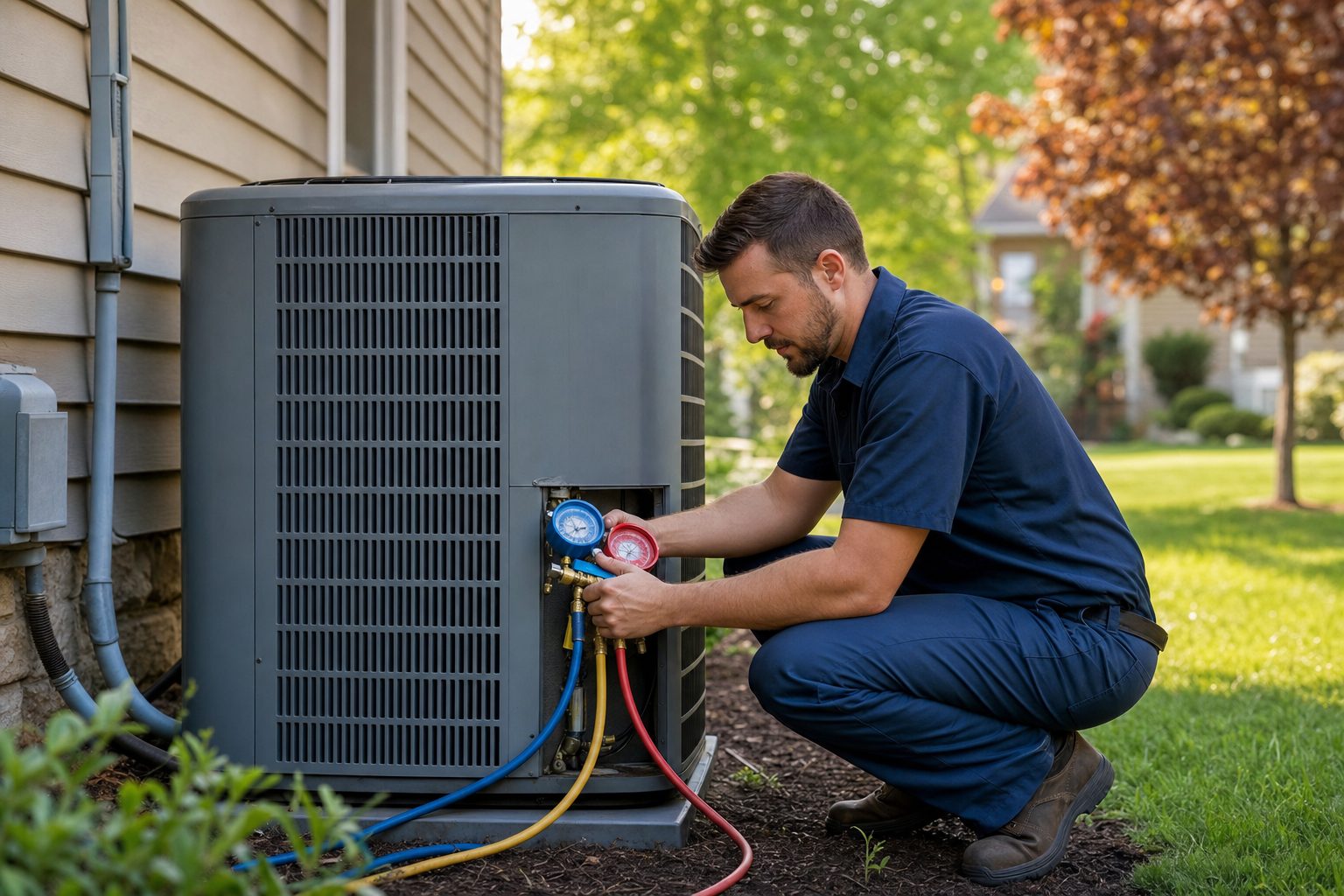
ENERGY STAR describes a ducted air-source heat pump as "a central air conditioner that also works in reverse to provide whole-house space heating in winter" (ENERGY STAR). That is why the two look almost the same from the yard. The four checks below separate them.
Check 1: The thermostat
Look at the mode settings on your wall thermostat or in its app.
- "EM HEAT," "EMER," or "Emergency Heat." This setting is almost only found on heat pump systems. It switches the house to backup heat strips when the heat pump can't keep up or needs service.
- "AUX" or "Auxiliary Heat." This shows when backup heat runs alongside the heat pump on very cold mornings.
- "O/B" wiring terminal. If you are comfortable removing the thermostat face (power off at the breaker first), an O or B terminal with a wire attached usually controls a heat pump's reversing valve. A standard AC with a gas furnace usually has no wire there.
If your thermostat only shows "Heat," "Cool" and "Off," you still need the other checks. Some smart thermostats hide these labels in their settings.
Check 2: The outdoor unit in winter
On a cool day, set the thermostat to heat a few degrees above the room temperature and go outside after a few minutes.
- Fan spinning and the compressor humming: the outdoor unit is helping heat the house, so it is a heat pump.
- Outdoor unit silent while warm air comes from the vents: your heat comes from somewhere else, usually a gas furnace or electric heat strips, and the outdoor unit is an air conditioner.
Heat pumps also run short defrost cycles in cold, damp weather. You may see light steam rising from the unit and hear a "whoosh" when the reversing valve shifts. That is normal for a heat pump and never happens on an AC-only unit.
Check 3: The outdoor nameplate (the most reliable check)
Every outdoor unit has a metal or foil data plate, usually on the side panel near the service valves. Take a photo of it and look for:
- HSPF or HSPF2. This is a heating efficiency rating. Only heat pumps carry it. An air conditioner lists SEER or SEER2 only.
- "Heat pump" in the description, or a model number your contractor can look up.
- A reversing valve on the line set. On many heat pumps you can see a brass, cylinder-shaped valve near the compressor with an electrical coil attached.
You can also search the model number in the AHRI Directory. The listing will show whether the equipment is rated as a heat pump or an air conditioner, and the AHRI certificate is what rebate programs usually ask for when you replace it.
Check 4: The indoor unit
Open the closet, attic hatch or garage space where the indoor unit sits.
- Gas furnace: a gas line with a shut-off valve, a flue pipe going up through the roof, and usually a small window to see the burner. If you have a gas furnace and the outdoor unit doesn't run in heat mode, you have a central AC plus furnace.
- Air handler with heat strips: no gas line or flue, only electrical wiring, often with a label that lists heater kilowatts (for example "10 kW heat kit"). This pairs with either a heat pump or, in older homes, an AC with electric resistance heat. The outdoor-unit check (Check 2) tells you which.
- Dual fuel: a gas furnace and an outdoor unit that runs in heat mode until it gets cold. This is a heat pump with gas backup. Program rules for dual fuel systems vary, so read each utility's page.
What it means for Texas rebates
Once you know your current system, compare it with the program for your area. Each utility sets its own equipment, contractor and paperwork rules. We link to the official pages instead of quoting amounts here, so you always see the current figures.
- Oncor (Dallas–Fort Worth and much of North and West Texas): As of November 10, 2026, Oncor's heating and cooling page says 2026 funding for its Home Energy Efficiency and Low-Income Weatherization programs has been fully exhausted, and to check back for 2027 program updates (Oncor). Our Oncor rebates guide tracks the status.
- CenterPoint Energy (Houston electric area): CenterPoint says central A/C, heat pumps and mini-split systems are all eligible for HVAC incentives, starting at 15.2 SEER2, and the incentive is applied to the invoice when you use a participating contractor (CenterPoint). See CenterPoint rebates.
- CPS Energy (San Antonio): CPS lists separate Home Energy Rebates for central air and for heat pumps under its STEP program (CPS Energy). See CPS Energy rebates.
- Austin Energy: Austin Energy lists an air conditioning rebate, a heat pump water heater rebate and whole-home Home Energy Savings rebates on its residential page (Austin Energy). See Austin Energy rebates.
- Gas side (North and Central Texas): if Check 4 shows a gas furnace, Atmos Energy lists Mid-Tex appliance rebates for gas equipment.
For every Texas program on one page, start with Texas energy rebates. For how heat pump programs compare across states, see heat pump rebates by state.
See if you qualify →
We help you check your utility and which program your project may fit before you sign.
If your system is 10 years old or more
Age matters as much as type. A unit that is 10 to 15 years old, needs frequent repairs or uses an older refrigerant is a good candidate for a planned replacement rather than an emergency one. A planned swap gives you time to read the program rules, collect three quotes and confirm the contractor participates. Our guide to how long AC units last covers the warning signs. If you're deciding between a heat pump and a gas furnace for your next system, read heat pump vs furnace, and our Texas HVAC rebates guide explains how programs and contractor rules fit together. Pricing a replacement? See what a heat pump costs in Texas.
Quick reference
| What you see | Heat pump | AC + gas furnace | AC + electric heat strips |
|---|---|---|---|
| "EM HEAT" or "AUX" on thermostat | Usually | No | Sometimes |
| Outdoor unit runs in heat mode | Yes | No | No |
| HSPF or HSPF2 on nameplate | Yes | No | No |
| Gas line and flue at indoor unit | Only if dual fuel | Yes | No |
| Defrost "steam" in winter | Yes | No | No |
FAQ
Can a heat pump and an AC look the same outside?
Yes. A ducted heat pump's outdoor unit looks almost identical to a central air conditioner. ENERGY STAR describes it as a central AC that also works in reverse for winter heat. The nameplate rating (HSPF or HSPF2) is the clearest difference.
My thermostat has "EM HEAT." Does that prove I have a heat pump?
It is a strong sign. Emergency heat is a heat pump feature that switches to backup heat strips. Confirm with the outdoor nameplate.
What is a dual fuel system?
A heat pump paired with a gas furnace. The heat pump heats on mild days and the furnace takes over when it gets cold. Rebate rules for dual fuel systems vary, so check your utility's page.
Do Texas rebates treat heat pumps and ACs differently?
Often, yes. Programs such as CPS Energy's list heat pumps and central air as separate rebates, and equipment efficiency minimums apply. Read the program page for your utility, or let us check your address.
Where do I find my model number?
On the data plate of the outdoor unit, usually on the side panel. Search it in the AHRI Directory, which also provides the certificate most programs request.
Sources
- ENERGY STAR, Air-source heat pumps: https://www.energystar.gov/products/air_source_heat_pumps
- U.S. Department of Energy, Heat pumps: https://www.energy.gov/heat-pumps
- AHRI Directory of Certified Product Performance: https://www.ahridirectory.org/
- Oncor, Heating and cooling: https://www.oncor.com/content/oncorwww/talot/en/home/residential/heating-and-cooling.html
- CenterPoint Energy, Heating and cooling: https://www.centerpointenergy.com/en-us/savings-solutions/energy-efficiency/heating-cooling
- CPS Energy, Home efficiency rebates: https://www.cpsenergy.com/en/my-home/savenow/home-efficiency-rebates.html
- Austin Energy, Residential rebates: https://austinenergy.com/energy-efficiency/rebates-incentives/residential
Know your system type? Tell us your ZIP and what you have now, and we'll show which programs your home may qualify for.
See if you qualify →
Quick to check · No obligation.
Questions? Email [email protected].
