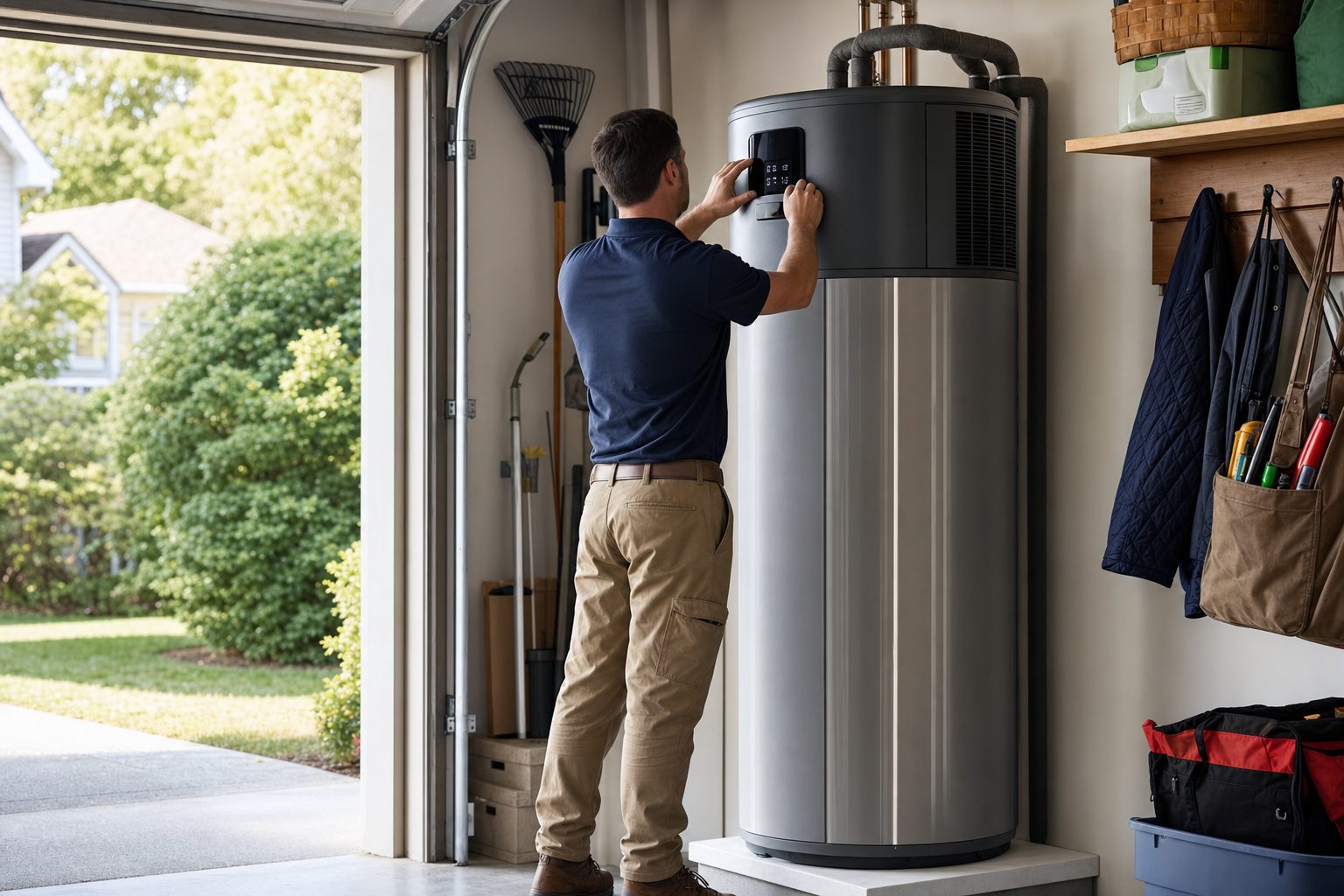
Tankless Water Heater Maintenance: Flushing and Winter Care
Short answer: A tankless water heater needs two kinds of regular care: flushing scale out of the heat exchanger and cleaning the inlet screen filter. How often depends on your water and your model. DOE says manufacturers' flushing schedules range from twice a year to once every three years, and Rinnai, a major manufacturer, says to flush at least once a year. In freezing weather, keep power and gas on so the unit's built-in freeze protection works, and insulate exposed pipes. If the power goes out for a long time in a freeze, drain the unit the way your manual describes.
Last checked November 15, 2026, against the U.S. Department of Energy, the U.S. Geological Survey, the U.S. EPA, Rinnai, Atmos Energy, Oklahoma Natural Gas and Texas Gas Service. Your owner's manual comes first. Steps and schedules differ by model.
Why tankless units need flushing
- Scale builds up inside. DOE's Measure Guideline says calcium and other minerals in the water can build up as scale in the heat exchanger. In a tank heater, scale settles at the bottom. In a tankless unit, it can restrict water flow through the heat exchanger and shorten the unit's life.
- Heat speeds it up. The U.S. Geological Survey (USGS) says that when hard water is heated, solid deposits of calcium carbonate can form, and that this scale can reduce the life of equipment and raise the cost of heating water.
- Higher temperatures make it worse. DOE's fact sheet says scaling is likely when a tankless unit runs at higher temperature settings with mineral-heavy water, and that the heating coils should be flushed with a descaling solution.
How hard is your water?
USGS classifies water hardness (as calcium carbonate) like this:
| Hardness (mg/L) | USGS classification |
|---|---|
| 0 to 60 | Soft |
| 61 to 120 | Moderately hard |
| 121 to 180 | Hard |
| More than 180 | Very hard |
Your water utility can tell you how hard your water is. EPA explains how to find your utility's annual water quality report, called a Consumer Confidence Report. If you're on a private well, have the water tested.
When a softener comes up. DOE says that if supply water hardness exceeds about 8 to 14 grains per gallon (136 to 239 ppm), some manufacturers may require a water softener to keep the unit efficient or prevent failure. Check your model's manual and warranty terms.
Tankless maintenance schedule
| Task | How often | Who |
|---|---|---|
| Flush (descale) the heat exchanger | Per your manual: DOE says manufacturer schedules range from twice a year to once every three years; Rinnai says at least once a year | Rinnai says a professional installer |
| Check and clean the inlet screen filter | Periodically; Rinnai says it depends on your water quality | Rinnai says a service technician |
| Check the vent and condensate drain are clear | Before and during freezing weather | Homeowner (look only); call a pro for repairs |
| Insulate exposed hot and cold pipes | Once, then check each fall | Homeowner or plumber |
Harder water and heavier use point to the shorter end of the range. Your manual sets the schedule for your unit.
How flushing works
Flushing runs a descaling solution through the heat exchanger to dissolve mineral buildup, which is the method DOE's fact sheet describes. Rinnai says the flush should be done by a professional installer, and that the time between flushes depends on your water quality.
If you're thinking about doing it yourself:
- Read your manual first. Valve locations, the right descaling product and the steps differ by brand and model.
- Shut off power and gas first. Rinnai's draining steps start with shutting off the cold water and gas and disconnecting power to the unit.
- Know your valves. Rinnai's steps refer to hot and cold isolation valves and drain valves on the water lines. If you can't find them on your install, ask a plumber.
- Don't skip the filter. Rinnai lists checking and cleaning the in-line screen filter as one of the two regular maintenance tasks.
If you're not comfortable with gas, water and electrical shutoffs, hire a licensed plumber.
Winter care in Texas and Oklahoma
Rinnai says tankless water heaters can be more prone to freezing than tank heaters because they don't hold a large volume of hot water. Its cold-weather guidance:
- Keep power to the unit. Built-in freeze protection works only while the unit has power. Rinnai says its own units are protected down to -22°F for indoor models and -4°F for outdoor models when they have power and gas and are shielded from direct wind. Other brands have their own ratings, so check your manual.
- Insulate exposed pipes. Rinnai says the unit's freeze protection doesn't cover the pipes and valves outside it. Insulate pipes that run outside or through unheated spaces.
- Keep the vent and condensate drain clear. Rinnai says ice or snow blocking them can cause problems or damage.
- In a long power outage, drain the unit. Rinnai's general steps: shut off the cold water and gas, turn off the controller, disconnect power, close the hot and cold isolation valves, open the pressure relief valve, open the hot and cold drain valves, and drain the condensate trap if your unit has one. Follow your own manual.
- Consider a drain-down kit. Rinnai recommends an optional drain-down system for outdoor units in cold climates. It drains the unit automatically if power or gas is lost.
DOE also notes that a tankless unit doesn't run during a power outage. If you want hot water when the power is out, a battery backup sized for the unit is one option.
When maintenance isn't enough
If the unit keeps losing temperature, shows error codes after a flush, or leaks, have it inspected. See the signs your water heater is going out and how a tankless water heater works.
If you replace it, some gas utilities list rebates on efficient tankless units:
- Atmos Energy (Mid-Tex Division): up to $200 for a natural gas tankless water heater at 0.87 UEF or higher, or up to $300 for an ENERGY STAR model at 0.95 UEF or higher. See our Atmos Energy rebates page.
- Oklahoma Natural Gas: up to $325 for a natural gas tankless water heater at 0.80 UEF or higher. ONG says rebates are limited and paid while program funds last. See our Oklahoma Natural Gas rebates page.
- Texas Gas Service: no rebate program right now. See Texas Gas Service rebates.
Each amount is per water heater, from your own gas utility only. For sizing and price, see what size tankless water heater do I need? and tankless water heater cost. For every program in one place, see our Texas energy rebates and Oklahoma energy rebates guides.
FAQ
How often should I flush a tankless water heater?
Follow your manual. DOE says manufacturer schedules range from twice a year to once every three years, depending on the model, how much you use it and your water quality. Rinnai says at least once a year.
Can I flush a tankless water heater myself?
Some homeowners do, but Rinnai says the flush should be done by a professional installer. Steps and descaling products differ by model, and the work involves gas, water and electrical shutoffs.
Do I need a water softener for a tankless water heater?
It depends on your water and your model. DOE says some manufacturers may require a softener when hardness exceeds about 8 to 14 grains per gallon. Your water utility can tell you how hard your water is.
Will my tankless water heater freeze?
Many units have built-in freeze protection that works only with power (and, for Rinnai, gas). The pipes and valves outside the unit aren't covered, so insulate them. In a long outage during a freeze, drain the unit per your manual.
Are there rebates for a new tankless water heater?
From some gas utilities. Atmos Energy's Mid-Tex Division lists up to $200 or up to $300, depending on efficiency, and Oklahoma Natural Gas lists up to $325. Texas Gas Service has no rebate program right now.
Is Upgrade Rebates a utility or plumbing company?
No. Upgrade Rebates is independent. We help homeowners understand which programs may fit and connect them with a licensed contractor.
Sources
- U.S. Department of Energy, Building America, Measure Guideline: Transitioning to a Tankless Water Heater: https://www1.eere.energy.gov/buildings/publications/pdfs/building_america/measure_guide_tanklesswh.pdf
- U.S. Department of Energy, Building America, Tankless Water Heaters: https://www1.eere.energy.gov/buildings/publications/pdfs/building_america/tankless_water_heaters.pdf
- U.S. Geological Survey, Hardness of Water: https://www.usgs.gov/special-topics/water-science-school/science/hardness-water
- U.S. EPA, Consumer Confidence Reports: https://www.epa.gov/ccr
- Rinnai, Freeze Protect Your Rinnai Product: https://www.rinnai.us/residential/freeze-protect-your-rinnai-product
- Rinnai, Residential FAQ: https://www.rinnai.us/residential/faq
- Atmos Energy, Mid-Tex Appliance Rebate Program: https://www.atmosenergy.com/ways-to-save/mid-tex-appliance-rebate-program/
- Oklahoma Natural Gas, Water Heater Rebate Information: https://www.oklahomanaturalgas.com/media/ONG/EEPLearnMore/Homeowner/ONG-Rebate-Learn-EE-Water-Heater-092026.pdf
- Texas Gas Service, Energy Efficiency Program (status): https://www.texasgasservice.com/save-money/energy-saving-tools-tips/energy-efficiency-program
Tankless unit on its last legs? Tell us your ZIP and a few details about your home. We will email a confirmation. A specialist may follow up to go over your answers and the programs that may fit.
See if you qualify →
Quick to check · No obligation.
Questions? Email [email protected].
